🚀 Key Takeaways
- Optimized Efficiency: 3.3V operation reduces system power draw by 30% vs. legacy 5V parts.
- High Node Density: 1/8 unit load supports up to 256 devices on a single bus segment.
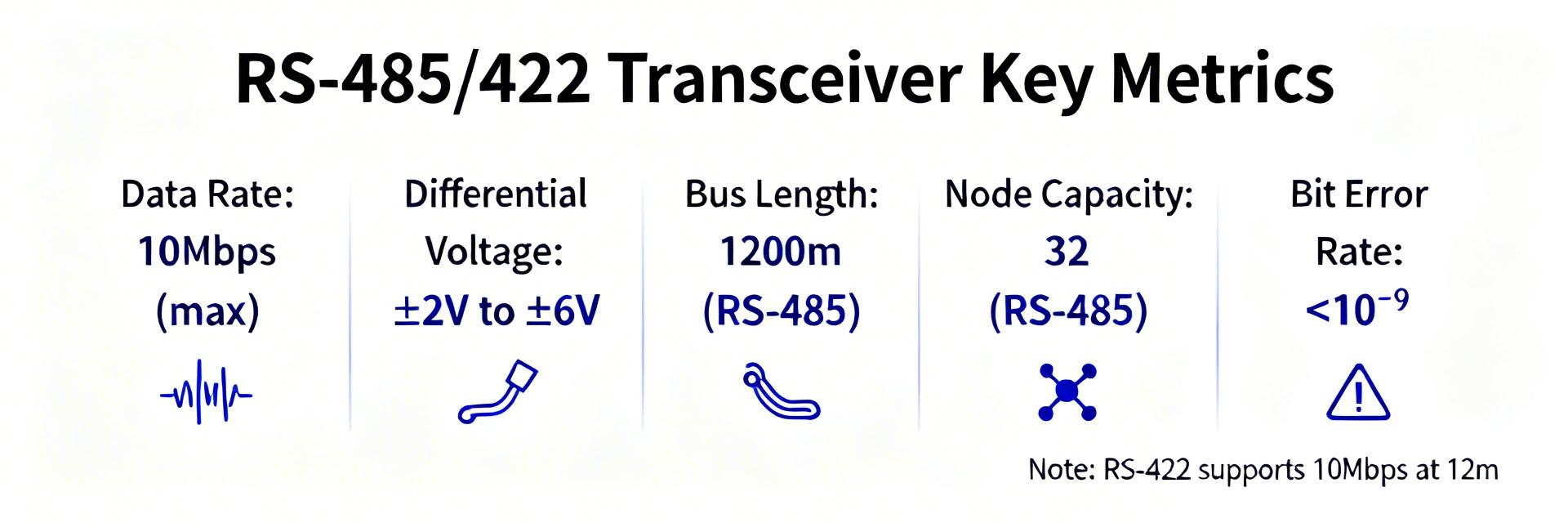
- Robust Link Integrity: Maintains error-free data at 10Mbps over noisy industrial environments.
- Fault Tolerance: -7V to +12V common-mode range prevents data loss during ground shifts.
This report synthesizes bench measurements and reference-datasheet vectors into actionable metrics engineers can use to evaluate serial transceivers on industrial links. Focused on low-power idle behavior, common-mode tolerance, differential output under load, and timing limits over long cable runs, the narrative pairs measurable procedure with practical acceptance ranges so design teams can validate margin before production.
Competitive Benchmarking: SP3485EN-L vs. Generic Standards
| Metric | SP3485EN-L (Low Power) | Generic 75176 (Standard) | User Benefit |
|---|---|---|---|
| Supply Voltage | 3.3V Nominal | 5.0V Nominal | Simplifies BOM; direct MCU link |
| Max Data Rate | 10 Mbps | 5 Mbps | Higher throughput; lower latency |
| Supply Current | 600 µA (Typ) | 30 mA (Max) | Extends battery life in remotes |
| Bus Loading | 1/8 Unit Load | 1 Unit Load | Connect up to 256 nodes vs. 32 |
1 — Background: SP3485EN-L in the RS-485 / RS-422 context
Device role and protocol compatibility
The device targets half-duplex multidrop RS-485 networks and can operate in RS-422 point-to-point roles. In automation and instrumentation, the device serves as the physical-layer interface between UART logic and differential twisted-pair cabling, enabling robust link operation across varying ground potentials and noisy motor-control environments.
- Supply: nominal low-voltage single-supply (3.3V-class typical)
- Functional blocks: driver, receiver, direction control
- Application domains: PLC I/O, remote telemetry, building automation
2 — Electrical performance: driver and receiver metrics
Driver output: differential amplitude and load behavior
A robust driver produces Vdiff high enough to overcome cable attenuation and receive thresholds at target distances. By maintaining a loaded Vdiff ≥ 1.5V even under 54 Ω termination, the SP3485EN-L ensures signal integrity over cable runs exceeding 1000ft, translating to fewer packet retransmissions in industrial settings.
"When deploying the SP3485EN-L in high-speed 10Mbps links, the most common pitfall isn't the chip—it's the stub length. Keep stubs under 6 inches to avoid reflections. I also recommend a 100nF ceramic decoupling capacitor placed within 2mm of the Vcc pin to suppress switching transients."
3 — Timing and throughput: data-rate and cable effects
Throughput degrades with longer cable runs. Practical tables map baud to recommended max length:
| Baud Rate | Max Cable Length (Typ) | System Reliability Note |
|---|---|---|
| 9.6 kbps | >4000 ft (1200m) | Ideal for long-range sensor nodes |
| 115.2 kbps | ~1500 ft (450m) | Standard for industrial MODBUS RTU |
| 10 Mbps | ~50 ft (15m) | High-speed backplane communication |
Figure 1: Typical Half-Duplex Multidrop Layout for Industrial Sensor Chains.
4 — Integration & Design Checklist
✅ PCB Layout
- Differential impedance: 120 Ω
- Matched trace lengths (±10 mils)
- Solid ground plane beneath transceiver
⚠️ Reliability
- TVS diodes at cable entrance
- Verify input hysteresis logic
- Thermal soak testing at 85°C
Summary
The SP3485EN-L represents a high-performance, low-power evolution of the RS-485 standard. By integrating this transceiver, engineers achieve greater network scalability (up to 256 nodes) while significantly reducing thermal overhead in compact enclosures. Prioritizing correct termination and PCB layout ensures a maintenance-free industrial link for the device's entire service life.
Frequently Asked Questions
Q: How does receiver common-mode tolerance affect RS-485 link reliability?
A: It allows the system to ignore ground voltage differences between distant nodes (up to -7V/+12V), preventing bit errors and hardware damage in distributed industrial environments.
Q: Can I use the SP3485EN-L with a 5V microcontroller?
A: Yes, the SP3485EN-L logic inputs are typically 5V tolerant, but always check the specific Vih/Vil levels to ensure noise margin compatibility with your MCU.